
Key Takeaways
- Milwaukee and DeWalt both run on effectively the same voltage – the “20V MAX” label is a marketing distinction, not a real power advantage.
- Milwaukee’s M18 FUEL platform leads in sustained heavy-duty power and carries a 5-year tool warranty, two years longer than DeWalt’s 3-year coverage.
- DeWalt’s ATOMIC DCK226D2 is the shortest 20V MAX hammer drill available, making it the clear winner for tight-space work – and it comes in at a lower entry price.
- The Milwaukee M12 4-Tool Kit (3494-24) packs the most tools-per-dollar in this comparison, making it a strong pick for tradespeople who need versatility on a budget.
- DeWalt’s 20V MAX ecosystem supports 300+ compatible tools versus Milwaukee M18’s 250+, giving DeWalt a slight edge for long-term platform investment.
Picking between Milwaukee and DeWalt comes down to what the job actually demands. Both brands build professional-grade cordless combo kits – the differences show up in sustained power, compact design, battery technology, ecosystem depth, and how long the warranty holds up over years of heavy use. This comparison breaks down four specific kits across both brands to show where each one earns its price tag.
18V vs. 20V MAX: The Voltage Myth That Changes Everything
Here’s something most tool ads won’t tell you: Milwaukee’s M18 and DeWalt’s 20V MAX batteries operate at the same nominal voltage. The “20V MAX” label reflects the battery’s peak charge voltage – the number right after it comes off the charger – while Milwaukee’s “18V” represents the standard discharge voltage during actual use. In real-world operation, both systems deliver the same working voltage. The difference is purely in how each brand chose to market the number.
This matters because it changes how to evaluate these tools. Voltage isn’t the deciding factor – motor architecture, battery cell quality, and thermal management are. The full Milwaukee vs. DeWalt breakdown at GenuineTools goes deeper into how these platforms stack up across real performance metrics, not just spec-sheet numbers. Once the voltage myth is out of the way, the actual differences between these brands become a lot clearer.
Milwaukee’s Two Platforms: Power vs. Portability
Milwaukee splits its cordless lineup into two distinct voltage platforms – the M18 for high-output professional work and the M12 for compact, lightweight trade applications. They don’t cross-charge, and they’re built for different use cases. Choosing between them is about matching the platform to the work.
M18 FUEL (3697-22): Best for Heavy-Duty Sustained Power
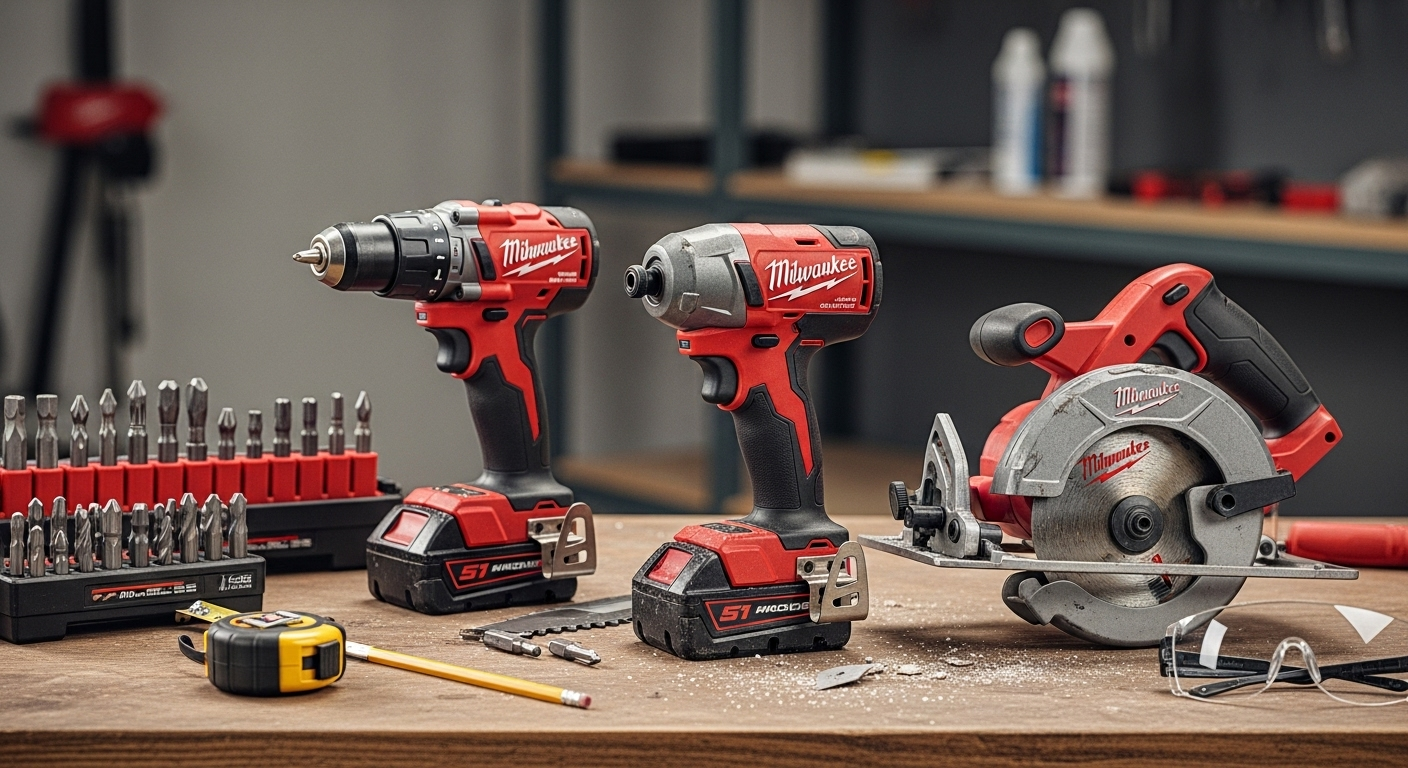
The Milwaukee M18 FUEL 2-Tool Combo Kit (3697-22) is built around one core promise: power that doesn’t fade under prolonged load. It pairs the M18 FUEL™ 1/2″ Hammer Drill/Driver with the M18 FUEL™ 1/4″ Hex Impact Driver, both driven by POWERSTATE™ brushless motors. These motors are engineered for sustained output – no thermal shutdown, no performance drop-off during long drilling sequences through concrete or dense hardwood.
The included M18 REDLITHIUM™ XC5.0 batteries (48-11-1850) add another layer of intelligence to the platform. Onboard electronics actively monitor temperature, overload, and discharge rates, protecting both the battery and the tool during demanding work cycles. The hammer drill also features AutoStop™ Control Mode, which detects sudden rotational bind-up and cuts power instantly – a meaningful safety feature on a tool capable of serious torque. Both batteries are compatible with 250+ tools in the M18 ecosystem.
At $284.99, it’s the most expensive kit in this comparison. It’s also the one built to handle a full commercial workday without compromise.
M12 4-Tool Kit (3494-24): Strong Value for Confined-Space Trades
The Milwaukee M12 3494-24 takes a different approach – four tools, a lighter footprint, and a price of $219.99. It’s aimed squarely at electricians, plumbers, and finish carpenters who spend their days working in wall cavities, panel boxes, and tight mechanical spaces where a full-size 18V tool simply won’t fit.
The kit includes the M12™ Subcompact Brushless 3/8″ Drill/Driver (3401-20) at just 5.4 inches long, the M12™ 1/4″ Hex Impact Driver (3450-20) at 4.3 inches, the M12™ Multi-Tool (2426-20) with 25% more runtime than competing 12V multi-tools, and the M12™ HACKZALL® Recip Saw (2420-20) at 11 inches and 2.2 lbs. Two CP2.0 REDLITHIUM™ batteries and a charger round out the package. The batteries are compatible with 150+ M12 tools.
The trade-off is ceiling: 12V limits peak torque and sustained output on heavier applications. For light framing or structural work, the M18 FUEL is the better choice. For trade professionals whose work prioritizes precision and access over raw power, the M12 kit delivers more utility per dollar than anything else in this roundup.
DeWalt’s 20V MAX: Compact Tech at a Lower Entry Price
DeWalt’s 20V MAX platform is one of the most widely adopted battery systems in the industry. Built around a single-voltage ecosystem that now spans more than 300 tools – from compact drills to table saws – two sub-lines are worth comparing here: the DCK228E2 with POWERSTACK™ battery technology, and the ATOMIC DCK226D2 purpose-built for tight spaces.
DCK228E2: POWERSTACK™ Delivers 50% More Power Than Comparable Standard 20V MAX Batteries
The DeWalt DCK228E2 pairs the DCD778 1/2″ Hammer Drill/Driver with the DCF840 1/4″ Impact Driver, both brushless. What sets this kit apart is the battery. The included DCBP034 POWERSTACK™ 1.7Ah packs use stacked pouch cells instead of traditional cylindrical cells. DeWalt says this design delivers 50% more power than a standard DCB203 compact battery, while being 25% more compact and 15% lighter – with twice the cycle lifespan.
In practice, that means more power output from a smaller, lighter battery that lasts longer through charge cycles. The DCD778 hammer drill reaches 28,050 BPM in hammer mode, and the DCF840 impact driver produces 1,700 in-lbs at up to 3,200 RPM. The main limitation is capacity – 1.7Ah is lower than a standard 2.0Ah pack, so heavy sustained use will cycle through charges faster. POWERSTACK is currently offered in 1.7Ah, 3.5Ah, and 5Ah, which still limits flexibility compared to DeWalt’s broader standard battery lineup.
ATOMIC DCK226D2: Shortest Hammer Drill for Tight Spaces
The DeWalt ATOMIC DCK226D2 ($159.99) is the most affordable kit in this comparison, and it earns its spot with one standout spec: the DCD799 1/2″ Hammer Drill/Driver is DeWalt’s shortest 20V MAX hammer drill at just 6.49 inches. In cabinet boxes, overhead joists, or wall cavities, that extra fraction of an inch matters. It pairs with the DCF809 1/4″ Compact Impact Driver, both brushless, and includes two 2.0Ah compact batteries.
The 2.0Ah batteries carry a slight runtime edge over the POWERSTACK 1.7Ah packs in the DCK228E2, though without the advanced cell technology. For general construction and renovation work that doesn’t demand maximum power density, the ATOMIC kit offers a practical, budget-conscious entry into the 300+ tool DeWalt 20V MAX ecosystem.
Head-to-Head: Power, Compactness and Battery Tech
Across these four kits, the performance gaps are real but specific:
- Peak power: Milwaukee M18 FUEL (3697-22) leads, with POWERSTATE™ brushless motors optimized for sustained load – no other kit here matches it for heavy continuous drilling.
- Battery innovation: DeWalt DCK228E2 wins on battery tech. POWERSTACK™’s 50% power boost over standard compact batteries is a genuine advancement, not just a marketing claim.
- Compactness: DeWalt ATOMIC DCK226D2 takes this category outright – 6.49 inches for a full hammer drill is class-leading. The Milwaukee M12 kit’s 5.4-inch drill is shorter, but it runs on 12V.
- Tools-per-dollar: Milwaukee M12 3494-24 delivers four tools, two batteries, charger, and bag for $219.99. Nothing else here comes close for variety at that price point.
Ecosystem Size: DeWalt’s 300+ vs. Milwaukee’s 250+ Compatible Tools
Platform lock-in is a long-term cost that rarely shows up in the initial purchase decision. Every battery bought, every charger added, every tool added to the collection deepens the investment in a single ecosystem.
DeWalt’s 20V MAX platform supports 300+ compatible tools, including a strong selection for woodworking and framing. Its FLEXVOLT system adds another layer – those batteries can power both 20V and 60V tools, giving DeWalt users access to full-size saws and demolition tools on the same battery platform. Milwaukee’s M18 ecosystem covers 250+ tools, with deep specialization in trades like electrical, plumbing, and HVAC. The M12 line adds 150+ tools designed for compact access work. If sheer ecosystem breadth is the priority, DeWalt holds the edge. If trade-specific depth matters more, Milwaukee’s dual-platform approach covers both ends of the power spectrum.
Warranty: Milwaukee’s 5-Year Edge Over DeWalt’s 3-Year
Milwaukee covers its power tools with a 5-year warranty – two full years longer than DeWalt’s standard 3-year coverage. For professional use where tools take daily abuse, that gap is meaningful. Both brands back their batteries separately: Milwaukee’s battery warranty varies by pack – M12 CP2.0 batteries typically carry a 2-year warranty, while many M18 XC packs carry a 3-year warranty. DeWalt includes a 1-year free service contract that covers maintenance and part replacement in addition to standard warranty terms. On a cost-per-year basis, Milwaukee’s tool warranty provides stronger long-term protection for tradespeople who depend on their tools to earn a living.
For Heavy Work, Choose Milwaukee – For Tight Spaces and Value, DeWalt Wins
The right answer depends entirely on how the tools get used day to day. Here’s how it breaks down:
- Heavy-duty sustained power: Milwaukee M18 FUEL (3697-22) – POWERSTATE™ motors, AutoStop™ safety, REDLITHIUM™ XC5.0 batteries, and a 5-year warranty built for full-day professional use.
- Best compact performance with advanced battery tech: DeWalt DCK228E2 – POWERSTACK™ batteries deliver 50% more power than standard compact packs in a lighter, smaller form factor.
- Tightest spaces: DeWalt ATOMIC DCK226D2 – 6.49-inch hammer drill, full brushless performance, lowest entry price at $159.99.
- Most versatile value: Milwaukee M12 3494-24 – four tools at $219.99, built specifically for trade professionals working in confined spaces all day.
Neither brand dominates across every category. Milwaukee earns its premium on sustained power and warranty length. DeWalt earns its reputation on ecosystem breadth, compact innovation, and accessible pricing. The best kit is the one that matches the specific demands of the job – not just the one with the most impressive spec on the box.
Genuine Tools
1500 NW Bethany Blvd.
STE 200
Beaverton
Oregon
97006
United States


