
Key Takeaways
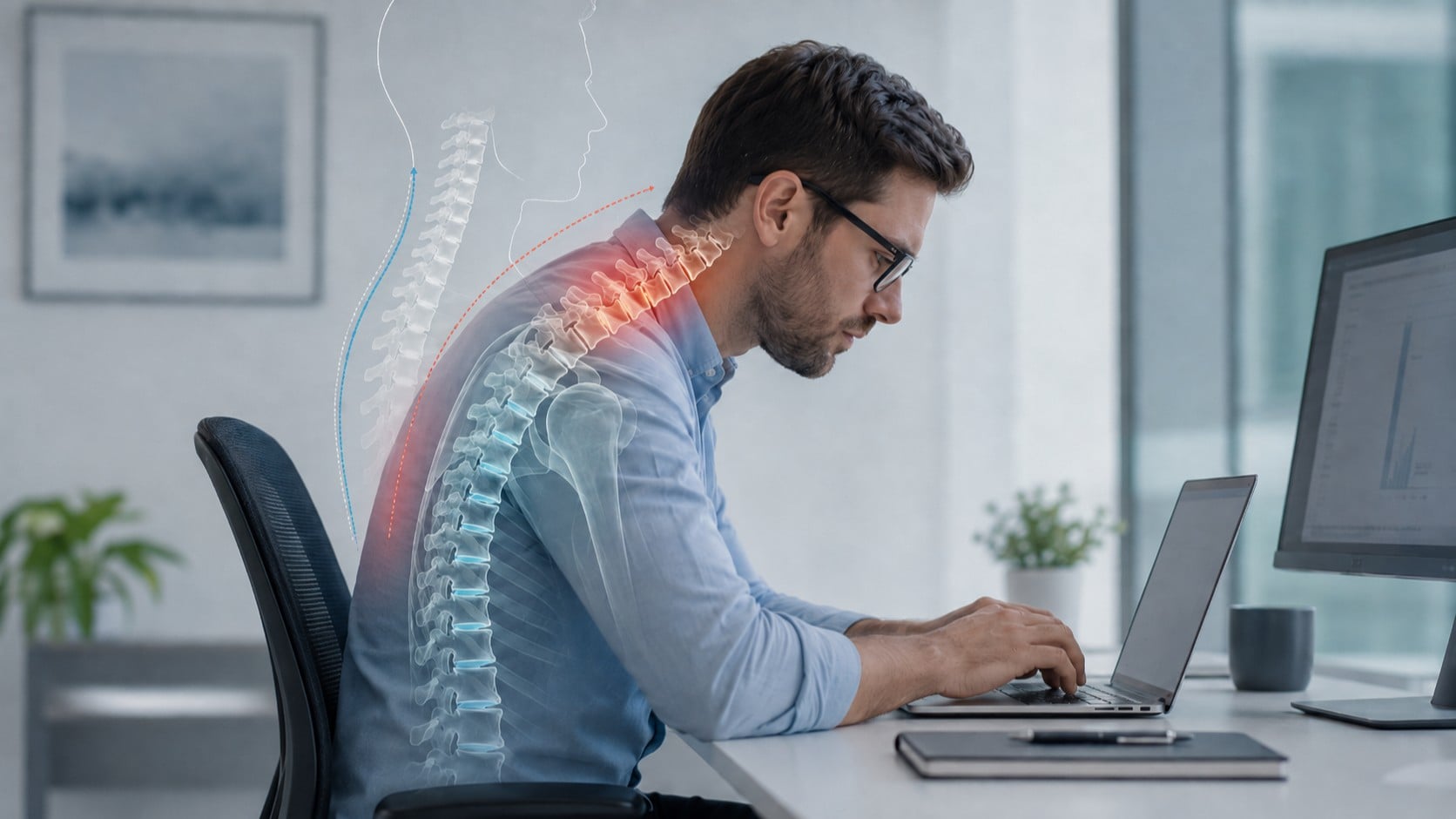
- Forward head posture is a structural shift of the cervical spine rather than a simple habit, which is why chin tucks and stretches often stop working after a few weeks.
- For every inch the head moves forward, the added weight creates roughly 10 to 15 pounds of extra pressure on the spine, turning ordinary posture into a heavy daily load on the muscles and spine.
- Hidden symptoms like afternoon brain fog, jaw clicking, dizziness, and reduced lung capacity are frequently traced back to forward head posture rather than stress or poor sleep alone.
- Left uncorrected, forward head posture can raise disc pressure, speed up spinal degeneration, and eventually lock the neck into a permanent hump.
- Restoring the natural cervical curve rather than strengthening muscles alone is the approach structural chiropractors use to address the root cause.
Anyone who has spent months doing chin tucks, buying “ergonomic” pillows, and stretching every night, only to feel the same neck stiffness creep back in a few days, is not imagining it. Forward head posture, sometimes called “turtle neck”, behaves less like a bad habit and more like a structural problem in the neck itself. Understanding why exercises alone often fall short is the first step toward finding something that actually holds.
One Inch Forward Doubles Head Weight
The head is heavy to begin with, sitting around 10-12 pounds when balanced directly over the shoulders. The moment it shifts forward, gravity stops being a neutral force and starts working against the neck muscles with surprising speed.
For every inch the head moves forward from its natural position, this forward shift adds roughly 10 to 15 pounds of extra pressure on the spine. At just a few inches of forward shift, that added load is enough to trigger numbness, disc damage, and constant fatigue. The muscles around the neck and shoulders are forced into a permanent low-grade spasm just trying to hold the head up against that extra gravitational load. Dr Will Kalla from Dr Neck Pain in Singapore has documented this progression in patients through X-ray measurement, tracking exactly how many millimeters the head has drifted and how much extra load that shift represents.
“Tech Neck” Habit vs. Structural Damage
“Tech neck” and forward head posture sound like the same thing, but they describe two very different situations. Tech Neck is a behavior: looking down at a phone, hunching over a laptop, or craning toward a monitor for hours. It comes and goes depending on what someone is doing in the moment.
Structural forward head posture is different. It is what happens when that behavior repeats for long enough that the cervical spine itself starts to change shape, and the forward position sticks around even after the phone is put down. A simple way to tell the difference is to notice whether the stiffness disappears once the device is away. If the neck still feels tight and the head still juts forward while standing tall and looking straight ahead, the habit has likely progressed into a structural condition.
Why Chin Tucks Can’t Restore Your Curve
Chin tucks are a common first line of defense, and they are not useless. They can strengthen the deep neck flexors and offer some short-term relief from tension. The problem is what they are being asked to do versus what they are actually capable of doing.
The neck relies on a natural inward curve called the cervical lordosis to distribute the head’s weight and cushion daily mechanical stress. Once that curve flattens or reverses, no amount of muscle strengthening can physically pull a vertebra back into its correct position against the constant pull of gravity. Muscles move joints, but they cannot reshape bone alignment on their own. Trying to fix a structural curve loss with muscle exercises alone is a bit like trying to straighten a bent picture frame by tightening the string on the back. The string might hold things steady for a moment, but the frame itself stays warped. This is why so many people plateau with generic stretches and posture apps: the exercises are working on the wrong layer of the problem.
The Hidden Symptoms You’re Missing
Forward head posture rarely announces itself with neck pain alone. Many of the symptoms it triggers show up far from the neck, which is exactly why they get missed or blamed on something else entirely.
Brain Fog and Afternoon Fatigue
That familiar 3 p.m. crash, the trouble focusing during a meeting, the heavy, tired feeling behind the eyes can trace back to something other than poor sleep or too much coffee. When the head shifts forward, it can place tension on the spinal cord and compress the arteries feeding the brain, reducing oxygen-rich blood flow. Less oxygen reaching the brain translates fairly directly into slower thinking and that persistent, hard-to-shake fatigue that seems to arrive right on schedule every afternoon.
Jaw Clicking and Dizziness
The neck and jaw are more connected than most people realize. Forward head posture creates tension in the muscles at the base of the skull, which can pull the jawbone out of its natural position and lead to clicking, popping, or difficulty chewing comfortably. Around the same region, misaligned vertebrae in the upper neck can send confused signals to the brain about where the head is in space, a phenomenon known as cervicogenic dizziness. That mismatch can cause unsteadiness or a spinning sensation, particularly when turning the head quickly. Some patients also notice ringing in the ears or tingling that travels down into the arms and hands as nerve pathways come under added pressure.
Shrinking Lung Capacity
Breathing is easy to take for granted until the mechanics behind it get disrupted. A forward-shifted head tends to round the shoulders and collapse the chest wall, which restricts how far the ribcage can expand. Research on forward head posture has linked this restriction to reduced vital lung capacity, in some cases by as much as 30 percent, along with slower airflow and weaker respiratory muscle activity. The result is shallower breathing throughout the day, even for people who consider themselves reasonably fit.
What Untreated Posture Does to Your Spine
Faster Spinal Degeneration Risk
When the cervical curve flattens, the joints and discs in the neck absorb far more mechanical stress than they were designed to handle. Over months and years, this accelerated wear can show up as early cervical spondylosis or general degenerative changes that would normally take decades longer to develop. The neck essentially ages faster than the rest of the body when it is forced to compensate for lost curvature every single day.
Rising Disc Herniation Risk
The discs between the cervical vertebrae act as cushions, but forward head posture keeps them under uneven, near-constant pressure. Research has found disc herniation rates as high as 79 percent among people with forward head posture, compared to 34 percent in those with normal alignment. That gap points to just how much extra strain a shifted head places on the delicate structures meant to protect the spinal cord. Left unaddressed, this pattern of pressure can also contribute to a permanently rounded upper back, sometimes referred to as a dowager’s hump, as the spine slowly calcifies into its compensated shape.
Restoring the Curve, Not Just Muscle
If exercises alone cannot rebuild a lost cervical curve, what actually can? Dr. Will Kalla explains that the answer lies in treating forward head posture as a structural issue that requires structural correction alongside muscular reinforcement, rather than muscular work alone.
Restoring the curve means physically guiding the cervical spine back toward its natural alignment, easing the tight muscles that have been pulling the head forward, and then retraining the body to hold that new position without constant conscious effort.
Structure, Not Habit, Drives Lasting Recovery
The most useful mental shift here is recognizing forward head posture as a spinal condition rather than a personal failing or a lack of discipline. Chin tucks, better desk setups, and mindful phone habits still matter, but they work best as maintenance tools once the underlying structure has actually been restored, rather than as a stand-alone fix for a curve that has already been lost.
A 2025 study published in Scientific Reports found that greater forward head posture was the most significant postural factor reducing the effectiveness of standard physical therapy treatment for chronic neck pain, which helps explain why so many well-intentioned stretching routines eventually stall out. Recognizing the difference between managing symptoms and correcting structure is often the turning point for people who have tried everything else without lasting results. For anyone ready to look at the actual shape of their cervical spine rather than just the symptoms it produces, learning more about forward head posture correction is a reasonable next step toward understanding what long-term relief actually requires.
Dr Neck Pain
ask@drneckpain.com
+65 8138 6880
420 North Bridge Road
02-20 North Bridge Centre
Singapore
SG
188727
Singapore


